Language, Survival, and Human History
Bread is everywhere. It sits quietly on breakfast tables, anchors sandwiches at lunch, and appears at dinners across cultures and continents. It feels ordinary, almost invisible in daily life. Yet the word bread carries a history as rich and layered as the food itself. Behind this short, familiar word lies a story shaped by language, survival, and the slow evolution of human societies.
A Word Older Than the Loaf
The English word bread comes from Old English brēad, but its original meaning may surprise you. In its earliest usage, brēad did not specifically refer to baked bread. Instead, it meant a piece, fragment, or bit of food. At that time, bread was not yet the dominant staple it would later become. Early European diets relied heavily on porridges, stews, and boiled grains, foods that were easier to prepare with simple tools.
As bread slowly gained importance, the word brēad evolved with it. What once meant a general piece of nourishment gradually narrowed in meaning until it came to describe baked grain products specifically. Language followed daily life, reshaping itself as bread moved from the margins of the diet to its center.
Before “Bread,” There Was “Loaf”
Interestingly, bread was not the earliest English word for baked grain food. That role belonged to hlāf, an Old English word that survives today as loaf. In early medieval England, hlāf referred to the baked item itself, while brēad remained a broader term for food.
As bread became increasingly central to survival, brēad replaced hlāf as the general word. Loaf remained behind as a more specific term. This shift reveals something profound. When a food becomes essential enough, it stops being just one item among many and starts representing nourishment itself. Bread did not just earn a place on the table. It earned ownership of the word.
Shared Roots Across Germanic Languages
English is only one branch of a larger Germanic language family, and bread has many close relatives. Old High German used brod, Middle Dutch had brood, and Old Norse spoke of brauð. The similarities are unmistakable. These words evolved in parallel across regions that shared farming traditions, grain cultivation, and communal baking practices.
Where grain grew reliably, bread followed. Where bread followed, language adapted. These linguistic cousins remind us that bread was not a luxury. It was a necessity that tied communities together, shaping vocabulary across borders long before modern nations existed.
A Different Story in Latin Languages
While Germanic languages formed bread, Latin-speaking cultures took a different path. The Latin word panis became the root for many modern Romance-language terms: pain in French, pane in Italian, pan in Spanish, and pão in Portuguese.
Although the words sound different, the role of bread remained the same. It was sustenance, stability, and survival. The divergence in naming shows how language reflects cultural lineage rather than the food itself. Bread united people nutritionally, even as words divided along linguistic lines.
Bread as a Measure of Life
Over time, bread became more than something you eat. It became a symbol of life and labor. That symbolism is deeply embedded in language. To earn one’s bread means to make a living. A breadwinner supports a household. To break bread together signifies trust, peace, and shared humanity.
These expressions did not arise by accident. For centuries, bread shortages led to unrest, famine, and even revolution. When bread was scarce, life became unstable. When bread was plentiful, societies flourished. Language absorbed these realities, turning bread into shorthand for survival itself.
The Evolution of Bread, the Evolution of Words
As people migrated, traded, and conquered, they carried bread-making knowledge with them. Each culture adapted bread to local grains, climates, and tastes. Flatbreads appeared where ovens were scarce. Fermented loaves emerged where yeast was discovered. Steamed breads developed in regions without wheat.
With each variation came a new name. Roti, naan, bing, tortilla, injera, pão. The list is long, but the concept remains universal. Grain transformed into nourishment through heat, time, and human ingenuity.
Language mirrors this diversity. The word bread may be English, but its meaning resonates globally. No matter the name, bread fulfills the same human need.
From Daily Food to Cultural Identity
Bread also shaped social structures. In medieval Europe, access to bread ovens was often regulated. Bakers held positions of responsibility. Grain storage meant security. Taxes were paid in wheat. Laws were written to protect bread quality and pricing.
Because bread was so central, its name carried weight. It became shorthand for fairness, provision, and order. A society that could guarantee bread could guarantee stability. That idea echoes today, even in places where bread is abundant.
A Word Kneaded by Time
The word bread did not appear fully formed. It was kneaded slowly by history, shaped by agriculture, and refined by daily use. Each generation passed it on, slightly altered, slightly narrowed in meaning, until it became the word we know today.
Like dough, language responds to pressure. Changes in diet, technology, and culture left fingerprints on the word. What began as a general term for food became the name of one of humanity’s most important staples.
Bread Today, Bread Forever
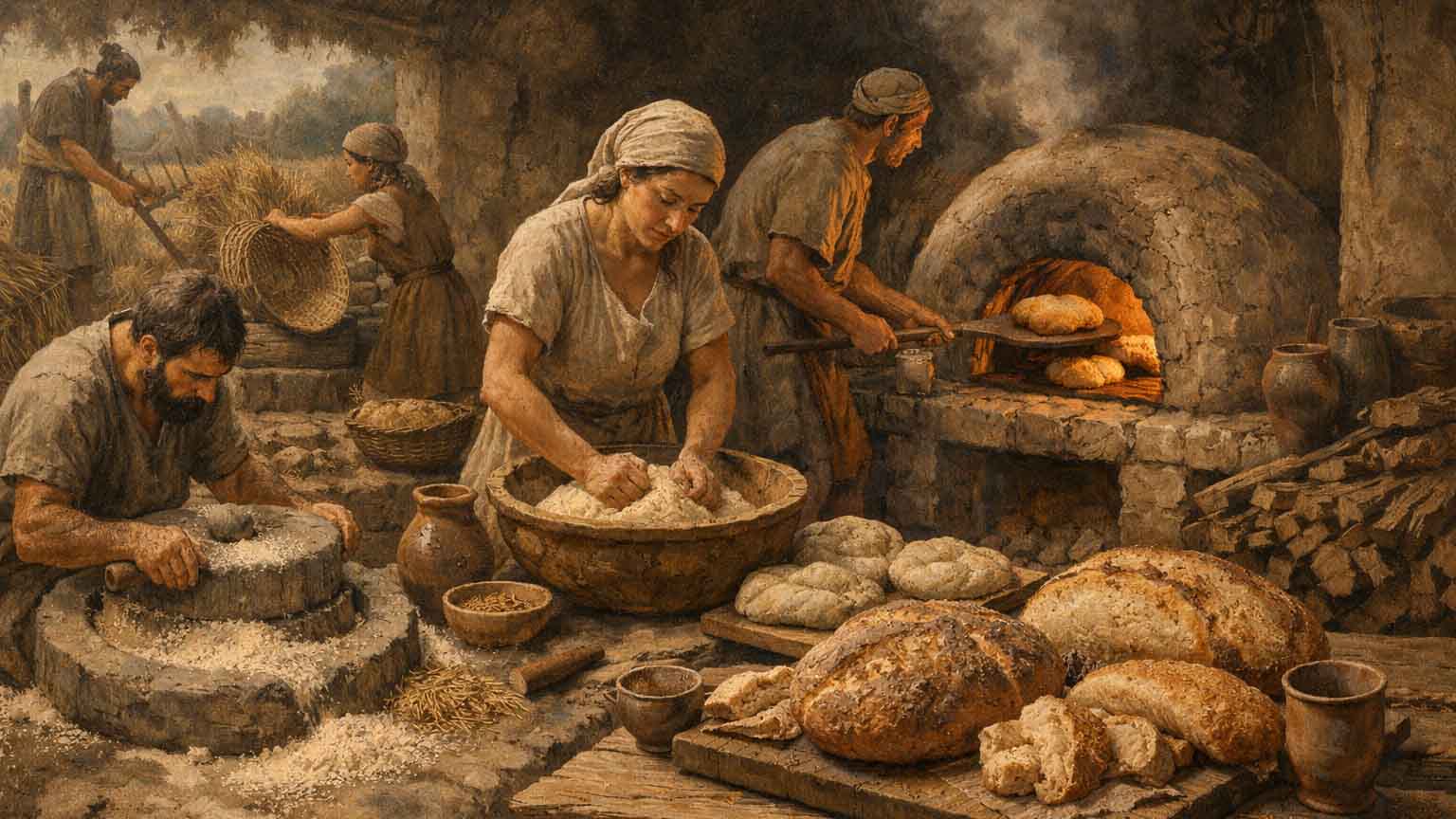
Today, bread is so common that its significance can be easy to forget. Yet every time the word is spoken, it carries echoes of ancient fires, stone mills, shared meals, and long journeys across continents.
Bread is not just baked grain. It is history made edible, language made tangible. Its name reflects humanity’s enduring relationship with the earth, with work, and with one another.
So when you say bread, you are not just naming food. You are invoking centuries of survival, adaptation, and connection. A simple word, shaped by human hands, rising quietly through time, one loaf at a time.