Life Before Agriculture
For the vast majority of human history, people lived as hunter-gatherers. Their diets depended entirely on what they could hunt, fish, gather, or dig from the land. Meat from wild animals, fish from rivers and coasts, fruits, nuts, seeds, and wild plants formed the core of daily nourishment.
There were no permanent fields, no stored grain, and no regular baking. Food was eaten fresh when possible or preserved through drying, smoking, or fermenting. Survival depended on mobility and knowledge of seasonal food sources rather than farming.
The Earliest Staple Foods
Before bread, staple foods existed, but they looked very different from what we know today. In many regions, roots and tubers played a central role. Foods like wild yams, cassava, and taro provided reliable calories and could be cooked over fire or buried in hot earth.
In other areas, people relied heavily on nuts and seeds, which could be stored for longer periods. Acorns, for example, were a major food source in parts of Europe, Asia, and North America. They required processing to remove bitterness, showing early humans already understood complex food preparation techniques.
Grains Before Bread
Wild grains existed long before bread, but early humans did not bake them. Instead, grains were often eaten as porridge or gruel. Seeds were crushed using stones, mixed with water, and cooked into thick, nourishing pastes. This method required no ovens and minimal tools.
These grain-based meals were easier to digest and provided sustained energy. In many ways, porridge was the true ancestor of bread. It marked the moment when humans began regularly processing grains rather than eating them raw.
The Shift Toward Farming
The transition from gathering to farming changed everything. Around ten to twelve thousand years ago, humans in several regions began domesticating plants. Wheat and barley in the Fertile Crescent, rice in East Asia, maize in the Americas, and millet in Africa all became foundations of settled life.
With farming came surplus. Surplus allowed storage. Storage created stability. Once grains could be grown, harvested, and saved, humans could stay in one place. This shift laid the groundwork for villages, cities, and eventually civilizations.
From Porridge to Dough
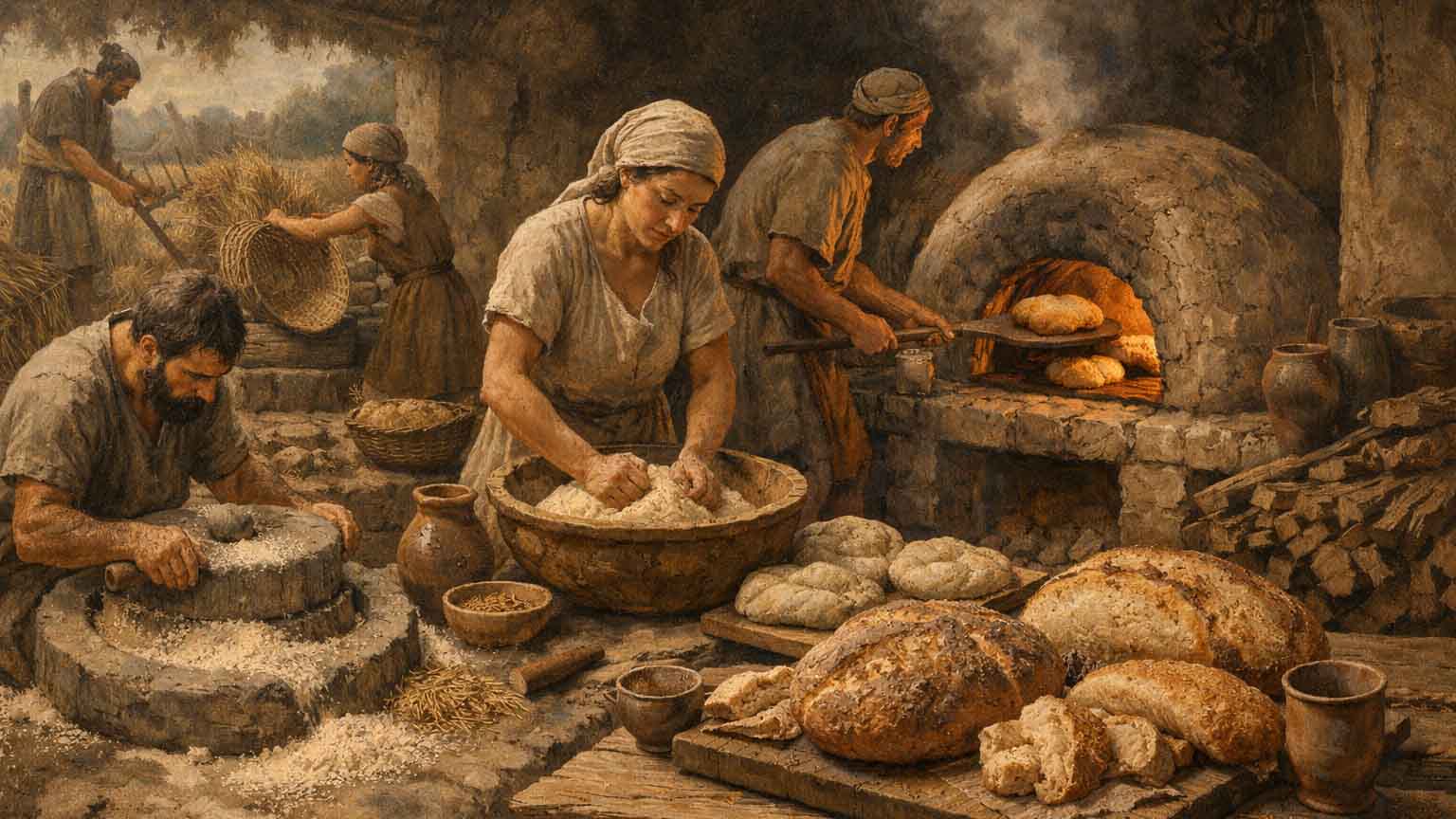
Bread did not appear overnight. Early grain foods were still boiled rather than baked. Over time, people discovered that thick grain pastes could be shaped and cooked on hot stones or in ashes. These early flatbreads were dense, simple, and often unleavened.
At some point, fermentation entered the picture. Natural yeasts in the environment caused dough to rise, creating lighter textures and new flavors. This discovery transformed grain paste into something closer to what we recognize as bread.
Why Bread Was Not Inevitable
It is important to understand that bread was not an inevitable invention. It emerged only where conditions allowed it. Baking bread requires specific grains, especially wheat and barley, which contain gluten. Gluten traps gas during fermentation, allowing dough to rise.
In regions without these grains, bread never became central. Instead, other staples continued to dominate. Rice was steamed, maize was nixtamalized, and roots were boiled or roasted. Each culture developed foods that made sense for its land.
Bread as a Late Arrival
Seen in this context, bread is relatively new. Humans lived successfully for tens of thousands of years without it. Bread became important not because it was superior, but because it suited the needs of settled agricultural societies.
It was portable, storable, and calorie-dense. It supported population growth and urban life. Bread did not replace earlier foods. It joined them, becoming dominant only in certain regions.
A Pattern, Not a Single Path
What came before bread was not one food, but many. Each culture relied on what was available and practical. The true constant in human history is not bread itself, but the idea of a staple: a reliable food that anchors daily life.
Bread is one expression of that idea. Before it came porridge, roots, nuts, meat, and countless other foods that sustained humanity through millennia.
Understanding this reminds us that food history is not linear. It is adaptive, regional, and deeply human. Bread tells one chapter of the story, but the chapters before it are just as rich, just as essential, and just as worthy of attention.